Economic Value Added and Traditional Accounting Measures for Shareholder’s Wealth Creation
DOI:
https://doi.org/10.17576/AJAG-2017-08-11Keywords:
EVA, traditional measures, shareholder’s wealth, dividend policy, MalaysiaAbstract
This paper investigated performance measurement tools and shareholder’s wealth relationships in the context of Malaysian public listed construction companies. Conventional measures are still utilized by many Malaysian listed companies even though it has been criticized by many researchers. Both traditional accounting measures and economic measures fail to reflect a company’s true value due to the lack of long-term sustainability of a business. The study used panel data analysis techniques, particularly Error Correction Models (ECM) to test the relationship of error terms and panel Ordinary Least Square (OLS) regression to test the hypothesis. Panel data comprised of 280 observations over the period of 2003-2012 indicates that shareholder value is a function of performance measures. The results conclusively support the claims made by previous studies on the role of earnings per share, economic value added (EVA) and dividend payout ratio; and further support the potential usefulness of the performance metric for internal and external performance. Furthermore, market value added (MVA) is found to have a negative relationship with created shareholder value (CSV) contradicting with the theory that confirmed, the increase in shareholder value when there is an increase in stock market value and efficiency.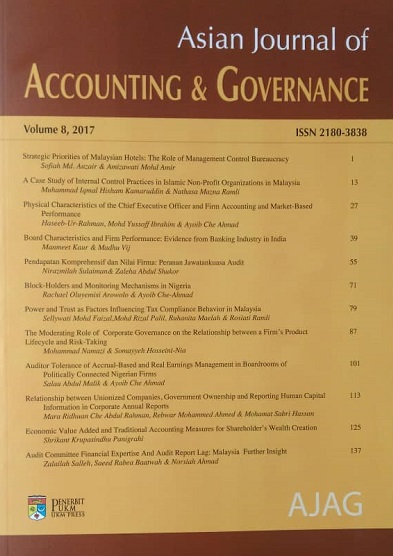
Downloads
Published
2017-11-17
Issue
Section
Articles
License
Authors who publish with this journal agree to the following terms:
- Authors retain copyright and grant the journal right of first publication with the work simultaneously licensed under a Creative Commons Attribution License that allows others to share the work with an acknowledgement of the work's authorship and initial publication in this journal.
- Authors are permitted and encouraged to post their work online (e.g., in institutional repositories or on their website) prior to and during the submission process, as it can lead to productive exchanges, as well as earlier and greater citation of published work (See The Effect of Open Access).
