Marxist Feminist Perspective of Corporate Gender Disclosures
DOI:
https://doi.org/10.17576/AJAG-2016-07-02Keywords:
Gender disclosures, women, sustainability reports, Fortune 500, human rights, Marxist FeminismAbstract
This paper argues that gender related corporate disclosure is a human right. The article builds this argument on the basis of Marxist feminism which highlights that the capitalistic mode of production is one of the reasons for women’s oppression and second category status in society. Thus, they face discrimination in many aspects of their lives. The paper also borrows the idea of Hazelton (2013) that access to specific information is a human right. The paper argues that a company’s stakeholders have a right to know about its gender practices and matters related to gender equality as the companies around the world are the representatives of the capitalistic mode of production and thus somewhat liable for the inferior status of women. A content analysis of the 2013 sustainability reports of selected Fortune 500 companies was undertaken to examine the gender disclosures. The content analysis was based on the six dimensions of gender disclosures as suggested by the GRI (2009) and disclosures were categorised into “hard” and “soft” disclosures (Clarkson et al. 2008). It was found that even though GRI had proposed gender disclosure guidelines in 2009, still the sample companies are not disclosing many of these suggested issues. Given recent developments in public concerns for increased transparency and accountability and the movement covering social, economic and environmental aspects of corporate performance, the paper argues that gender disclosures are also necessary.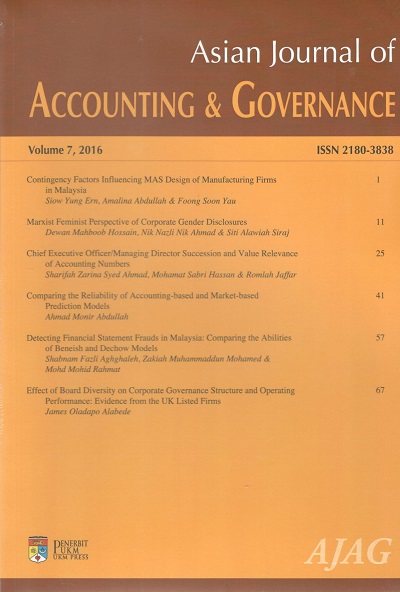
Downloads
Additional Files
Published
2016-11-03
Issue
Section
Articles
License
Authors who publish with this journal agree to the following terms:
- Authors retain copyright and grant the journal right of first publication with the work simultaneously licensed under a Creative Commons Attribution License that allows others to share the work with an acknowledgement of the work's authorship and initial publication in this journal.
- Authors are permitted and encouraged to post their work online (e.g., in institutional repositories or on their website) prior to and during the submission process, as it can lead to productive exchanges, as well as earlier and greater citation of published work (See The Effect of Open Access).
