Detecting Financial Statement Frauds in Malaysia: Comparing the Abilities of Beneish and Dechow Models
DOI:
https://doi.org/10.17576/AJAG-2016-07-05Keywords:
Beneish M-score, Dechow F-score, financial statement fraud, fraud detection, financial modelsAbstract
Financial statement frauds ( FSF ) are becoming rampant phenomena in current economic and financial landscapes. One of the ways to curb FSF is to detect them early so that preventive measures can be applied. This study aims to empirically investigate the abilities of two financial-based models namely the Beneish’s M-score and Dechow’s F-score, to detect and predict FSF for Malaysian companies. In addition, this study compares the accuracy including the error rates between the two models. Financial data of Malaysian listed companies from 2001 to 2014 are used using a matched pair in this study. The findings reveal that both Beneish and Dechow models are effective in predicting both the fraudulent and non-fraudulent companies with average accuracy at 73.17% and 76.22%, respectively. The results also indicate that Dechow F-score model outperforms the Beneish M-score model in the sensitivity of predicting fraud cases with 73.17% compared to 69.51%. On the efficiency aspect, the Dechow F Score model is found to have lower type II error (26.83%) than Beneish M Score model (30.49%). This finding suggests that Dechow F Score model is a better model that can be used by the regulators to detect FSF among companies in Malaysia.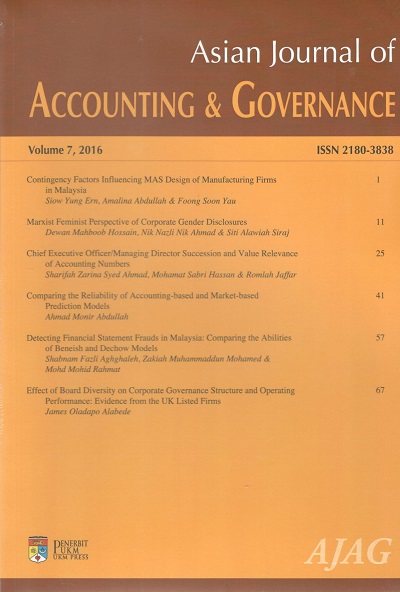
Downloads
Published
2016-11-03
Issue
Section
Articles
License
Authors who publish with this journal agree to the following terms:
- Authors retain copyright and grant the journal right of first publication with the work simultaneously licensed under a Creative Commons Attribution License that allows others to share the work with an acknowledgement of the work's authorship and initial publication in this journal.
- Authors are permitted and encouraged to post their work online (e.g., in institutional repositories or on their website) prior to and during the submission process, as it can lead to productive exchanges, as well as earlier and greater citation of published work (See The Effect of Open Access).
