Determinants of Intangible Assets Disclosure in Quoted Companies in Nigeria
DOI:
https://doi.org/10.17576/ajag-2015-6-12171Keywords:
Voluntary disclosure of intangible assets, Nigeria, Corporate attributesAbstract
This study examined the determinants of voluntary disclosure of intangible assets by quoted companies in Nigeria. A disclosure index, based on the modified Value Chain Scoreboard (VCSB), was constructed to measure the dependent variables in four (4) models. The VCSB is intended to inform both the manager and investors about the company’s innovational activities with emphasis on investment in intangible assets and their transformation to tangible results. The VCSB is described as a matrix of non-financial indicators arranged in three categories according to the circle of development (Lev 2001). The pooled and panel data, sourced from the annual reports and accounts of one hundred and fifty-seven (157) quoted companies for six (6) years from 2005 to 2010 were used. The Fixed Effects model was chosen for analysis of data. The findings revealed that Age of Company (AGEC) had a positive and significant influence on all classes of voluntary disclosures. Size of Audit Firm (SIZA) was positively and significantly related to overall voluntary disclosure of intellectual capital assets (VDIAOV), while the least disclosed class of intangible assets was voluntary disclosure of intangible assets relating to implementation (VDIAIM); and the most disclosed class was VDIACO. Given these findings, the regulatory authorities could grant awards in order to encourage more voluntary disclosure of intellectual capital by companies in relation to implementation since findings revealed that this phase of component is the least disclosed. Additionally, the big-4 audit firms can organize a mandatory continuous professional training as to extend their protocols and techniques in order to encourage more disclosures by companies audited by the non big-4 audit firms.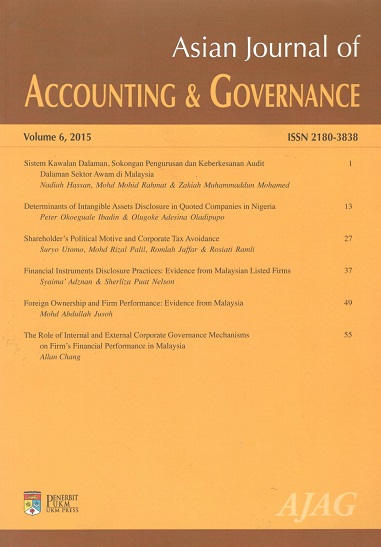
Downloads
Issue
Section
Articles
License
Authors who publish with this journal agree to the following terms:
- Authors retain copyright and grant the journal right of first publication with the work simultaneously licensed under a Creative Commons Attribution License that allows others to share the work with an acknowledgement of the work's authorship and initial publication in this journal.
- Authors are permitted and encouraged to post their work online (e.g., in institutional repositories or on their website) prior to and during the submission process, as it can lead to productive exchanges, as well as earlier and greater citation of published work (See The Effect of Open Access).
