Block-holders and Monitoring Mechanisms in Nigeria
DOI:
https://doi.org/10.17576/AJAG-2017-08-06Keywords:
Monitoring mechanisms, institutional block-holders, individual block-holders, agency problems, NigeriaAbstract
Companies continue to fold up after the global economic melt-down of 2008 starting with the Enron saga. One of the reasons offered by practitioners and intellectuals in their search for the cause and solution to the problem is information asymmetry between the managements and the shareholders. It is extremely necessary ever since the sagas and continuous business failures and financial distress in Nigeria, in particular, to focus on monitoring mechanisms (MM), especially in Sub-Saharan countries. In addition, it is essential to understand the factors relating to MM as it cannot work in isolation. The purpose of this study is therefore to examine the extent to which block-holders impact on MM using the annual reports of 111 Nigerian non-financial listed companies in the context of agency theory. In addition, data were collected from the companies in respect of their internal auditing using the questionnaire as these are not available in the annual reports. The findings provide evidence that the block-holders significantly relate to monitoring mechanisms. Thus, this paper provides a new knowledge regarding monitoring mechanisms and its antecedents (directorship, internal and external auditing). These findings are with policy implications for the board of directors to implement their monitoring responsibilities. The findings also suggest policy implications for the internal and external auditors. The findings are useful for further review of corporate governance guidelines by the regulatory agencies and government. The paper contributes to knowledge in Sub-Saharan Africa, Nigeria in particular by examining block-holders in relation to the aggregate cost of monitoring mechanisms (directorship, internal and external auditing).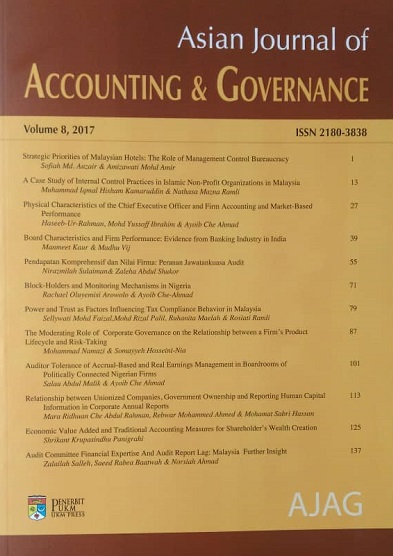
Downloads
Published
2017-11-17
Issue
Section
Articles
License
Authors who publish with this journal agree to the following terms:
- Authors retain copyright and grant the journal right of first publication with the work simultaneously licensed under a Creative Commons Attribution License that allows others to share the work with an acknowledgement of the work's authorship and initial publication in this journal.
- Authors are permitted and encouraged to post their work online (e.g., in institutional repositories or on their website) prior to and during the submission process, as it can lead to productive exchanges, as well as earlier and greater citation of published work (See The Effect of Open Access).
