A Case Study of Internal Control Practices in Islamic Non-Profit Organisations in Malaysia
DOI:
https://doi.org/10.17576/AJAG-2017-08-02Keywords:
Internal control, Company limited by guarantee (CLBG), Islamic charity fund, Islamic social accountingAbstract
This paper presents the current internal control practices of Islamic non-profit organizations in Malaysia. This study employs comparative case study method by using interview for its data collecting approach. Three Islamic non-profit organizations with similar characteristics were selected as samples for this study. Findings showed that several similarities in internal control practices aspects such as segregation of duties, authorisation of transactions and documentation of records in the organizations. Different practices were also identified, especially in physical control over assets and records and independent checks on performance aspects. The study found inadequate physical control over assets and records, such as installation of alarm and CCTV camera, hiring a guard over premises and also a barrier to financial documentations and room. Also two out of three Islamic non-profit organizations did not practise internal audit processes for independent checks on performance. Based on these findings, several suggestions were highlighted for improvement. This paper also identified issues and challenges in the internal control practices, such as lack of financial staff, low equipped physical control tools, not assigning internal auditor for frequent review over operation purposes and financial limitation.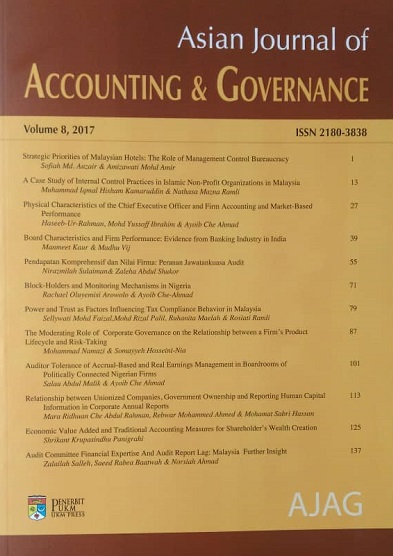
Downloads
Published
2017-11-17
Issue
Section
Articles
License
Authors who publish with this journal agree to the following terms:
- Authors retain copyright and grant the journal right of first publication with the work simultaneously licensed under a Creative Commons Attribution License that allows others to share the work with an acknowledgement of the work's authorship and initial publication in this journal.
- Authors are permitted and encouraged to post their work online (e.g., in institutional repositories or on their website) prior to and during the submission process, as it can lead to productive exchanges, as well as earlier and greater citation of published work (See The Effect of Open Access).
