Relational Signalling in Governance Mechanisms and Trust Building
DOI:
https://doi.org/10.17576/AJAG-2018-09-05Keywords:
Relational signalling, trust, inter-organizational collaboration, formal contract, management control system, knowledge exchange, innovation.Abstract
“Thick” trust is required for the exchange of tacit knowledge in inter-organizational innovation collaborations. Management accounting researchers suggest that when the governance mechanisms can provide sufficient mitigations to the relational risks, trusting relationship among the collaborating partners can be developed. However, the question that remained unanswered is why some collaborative relationships with proper governance structure do not lead to the establishment of trust. This study seeks to identify the relational signals in the formal governance mechanisms which could foster development of “thick” trust that is crucial for effective knowledge exchange. Based on resource-based view (RBV), transaction cost economics theory (TCE), and relational signalling theory, this study proposes a conceptual framework that identifies the relational signalling elements in formal governance mechanisms that could foster “thick” trust among partners. The study contributes to the literature by distinguishing specific elements from conventional formal governance mechanisms as relational signalling elements for effective development of trust among collaborating partners.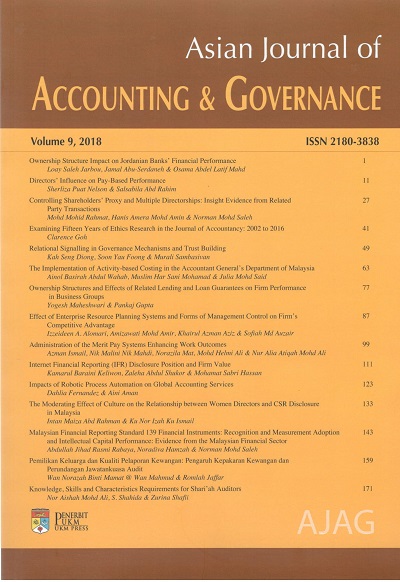
Downloads
Published
2018-05-07
Issue
Section
Articles
License
Authors who publish with this journal agree to the following terms:
- Authors retain copyright and grant the journal right of first publication with the work simultaneously licensed under a Creative Commons Attribution License that allows others to share the work with an acknowledgement of the work's authorship and initial publication in this journal.
- Authors are permitted and encouraged to post their work online (e.g., in institutional repositories or on their website) prior to and during the submission process, as it can lead to productive exchanges, as well as earlier and greater citation of published work (See The Effect of Open Access).
