Measuring Internet Financial Reporting (IFR) Disclosure Strategy
DOI:
https://doi.org/10.17576/AJAG-2017-08SI-02Keywords:
IFR disclosure strategy, internet technology, content analysis, IFR disclosure strategy checklistAbstract
There is a significant development in the accounting practices and communication due to the rapid growth of internet technology. Nonetheless, until today, financial reporting through the internet still has no legally structured standard compared to the formal international financial reporting standard (IFRS) that firms need to adhere. Yet, firms must still consider stakeholders’ decision making based on internet accounting disclosures. Since the 1990s studies on Internet Financial Reporting (IFR) apply various indexes to measure disclosure practices. However existing indexes mainly focus only on the level and quality of IFR disclosure. Our study develops a new checklist – IFR disclosure strategy checklist – to measure IFR disclosure strategy based on a taxonomy proposed by Williams (2008) which has not yet been empirically tested until today. However, the taxonomy only outlines the characteristics of each proposed strategy. Our study takes the challenge to interpret the taxonomy by developing a checklist for each characteristic that were describe in the taxonomy. Utilizing content analysis, detailed consideration was made about items in the checklist based on prior studies, available regulations in several countries as well as current practices by reporting entities. Results from reliability test indicate that our checklist is a valid and reliable instrument with regards to our sample of study. It is expected that our checklist will be referred to by reporting entities in order to assist stakeholders’ decision making. Eventually we hope that with the knowledge about the disclosure strategy, stakeholders might reduce their time and effort in searching for the best business entities when deciding upon their investment portfolio.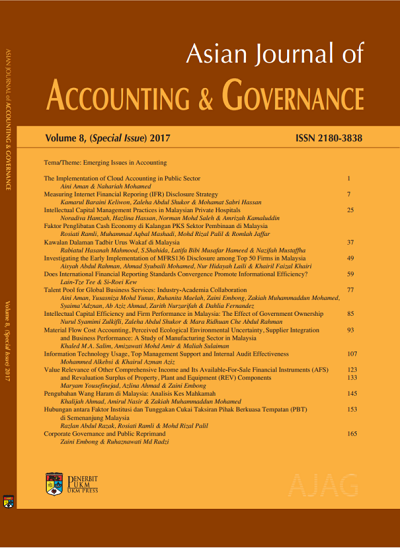
Downloads
Published
2018-02-12
Issue
Section
Articles
License
Authors who publish with this journal agree to the following terms:
- Authors retain copyright and grant the journal right of first publication with the work simultaneously licensed under a Creative Commons Attribution License that allows others to share the work with an acknowledgement of the work's authorship and initial publication in this journal.
- Authors are permitted and encouraged to post their work online (e.g., in institutional repositories or on their website) prior to and during the submission process, as it can lead to productive exchanges, as well as earlier and greater citation of published work (See The Effect of Open Access).
