Does International Financial Reporting Standards Convergence Promote Informational Efficiency?
DOI:
https://doi.org/10.17576/AJAG-2017-08SI-07Keywords:
Informational Efficiency, Stock Price Delay, International Financial Reporting Standard (IFRS), Emerging MarketAbstract
This study explores a novel extension of the informational efficiency literature. We examine the impact of the convergence of International Financial Reporting Standards (IFRS) on stock price delay in the Malaysian stock market over a study period 2001 to 2016. The study uses Hou and Moskowitz’s (2005) model to measure the stock price delay, an inverse indicator of informational efficiency. It is found that stocks have less delay on price adjustment to local and global market-wide information during the convergence of IFRS than before the IFRS was converged. Further, the panel data analysis is applied to test the empirical linkages between the convergence of IFRS and stock price delay. After controlling for trading volume, firm size, market volatility and financial crisis, we find strong evidence that the IFRS plays an essential role in promoting informational efficiency. Specifically, the convergence of IFRS decreases the local and global stock price delay. This is possibly due to the IFRS convergence promotes a more transparent reporting mechanism, reduces asymmetric information among market participants and thereby enhances stock price efficiency in incorporating information. The findings will be of help to policymakers in the effort to increase informational efficiency and those with interest in the subject.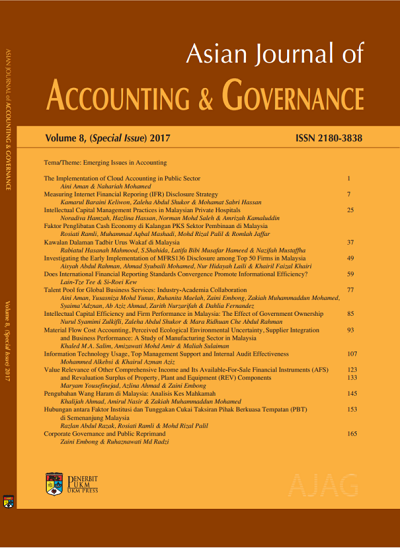
Downloads
Published
2018-02-12
Issue
Section
Articles
License
Authors who publish with this journal agree to the following terms:
- Authors retain copyright and grant the journal right of first publication with the work simultaneously licensed under a Creative Commons Attribution License that allows others to share the work with an acknowledgement of the work's authorship and initial publication in this journal.
- Authors are permitted and encouraged to post their work online (e.g., in institutional repositories or on their website) prior to and during the submission process, as it can lead to productive exchanges, as well as earlier and greater citation of published work (See The Effect of Open Access).
