Controlling Shareholders’ Proxy and Multiple Directorships: Insight Evidence from Related Party Transactions
DOI:
https://doi.org/10.17576/AJAG-2018-09-03Keywords:
controlling shareholder, proxy, multiple directorship, related party transactions, RPT-conflictAbstract
This study examines the association between controlling shareholders' networks (i.e., controlling shareholders’ proxy (CSProxy) and controlling shareholders’ multiple-directorships (CSMultiD)) and related-party transactions (RPTs), particularly involving controlling shareholders' interests (RPT-conflict). This study also examines the impact of interaction between CSProxy and CSMultiD on firm engagement with RPTs, and RPT-conflict. The hypotheses are tested using a sample of 548 listed companies in Malaysia over the period 2012-2014 with a total of 1,550 observations. The results show that CSProxy is not associated with RPTs, and RPT-conflict. The CSMultiD is also not associated with RPTs. However, it has a positive relationship with RPT-conflict. Additionally, an interaction between CSProxy and CSMultiD increases the likelihood of firms to engage and disclose more RPTs; in contrast, it discloses lower magnitude of RPT-conflict. The opportunistic controlling shareholders may exploit their conflict of interest for private benefits by hiding their intention behind the RPTs. Overall, these findings provide partial empirical support to the argument that controlling shareholders seek to use their network relationship to influence firms to engage with related parties. These findings raise concerns to the regulators and policy makers, specifically on the ability of the controlling shareholders in utilizing their position and networks opportunistically to expropriate firm resources for personal purposes.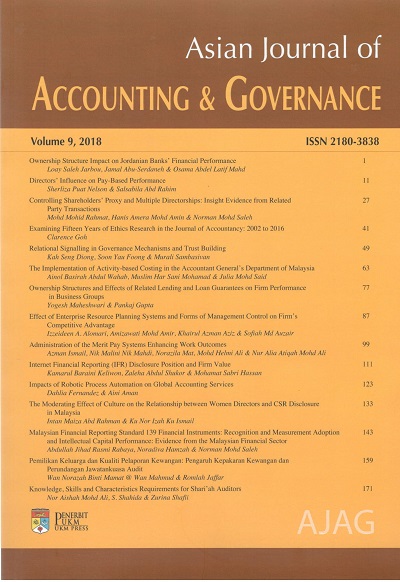
Downloads
Published
2018-05-07
Issue
Section
Articles
License
Authors who publish with this journal agree to the following terms:
- Authors retain copyright and grant the journal right of first publication with the work simultaneously licensed under a Creative Commons Attribution License that allows others to share the work with an acknowledgement of the work's authorship and initial publication in this journal.
- Authors are permitted and encouraged to post their work online (e.g., in institutional repositories or on their website) prior to and during the submission process, as it can lead to productive exchanges, as well as earlier and greater citation of published work (See The Effect of Open Access).
