Effect of Enterprise Resource Planning Systems and Forms of Management Control on Firm’s Competitive Advantage
DOI:
https://doi.org/10.17576/AJAG-2018-09-08Keywords:
Enterprise Resource Planning Systems, Forms of management control, Technocratic control, Socio-ideological control, Competitive advantageAbstract
In the brick of digitalization industry revolution era, this study signifies the pertinent role of Enterprise Resource Planning Systems (ERPs) towards assisting the organization towards attaining the firm’s mission and goal. This study extends the knowledge by exploring the relationship between ERPs and management control (MC), which in turn enhances firm’s competitive advantage. Realizing the limited empirical work on ERPs from management accounting and control perspective, the discussion would be drawn from business stakeholder’s perspective, instead of from information technology standpoint. The study views ERPs as an important resource in creating the capability to control the business operations and combination of both factors creates the firm’s competitive advantage. Survey questionnaires were administered via email to 972 randomly selected manufacturing firms listed in Federation of Malaysian Manufacturer Directory. Based on the 114 usable responses, the data was analyzed using a structural equation modeling (SEM) approach through partial least square (PLS) software. The findings provide empirical evidence on the significance of ERPs in determining firm’s MC approaches, both technocratic and socio-ideological forms of control. Evidently, these variables do associate positively with competitive advantage. Additionally, the analysis demonstrates that only technocratic form of MC mediates the relationship between ERPs and competitive advantage, but not for socio-ideological control. These findings provide an insight on the relationship among ERPs, form of MC and firm’s competitive advantage, which may be an input for businesses in facing the industrial digitalization era.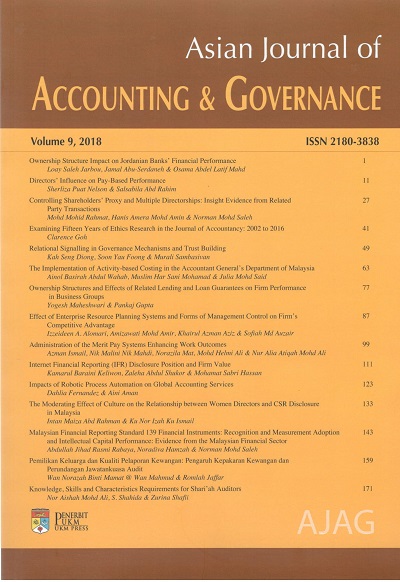
Downloads
Published
2018-05-07
Issue
Section
Articles
License
Authors who publish with this journal agree to the following terms:
- Authors retain copyright and grant the journal right of first publication with the work simultaneously licensed under a Creative Commons Attribution License that allows others to share the work with an acknowledgement of the work's authorship and initial publication in this journal.
- Authors are permitted and encouraged to post their work online (e.g., in institutional repositories or on their website) prior to and during the submission process, as it can lead to productive exchanges, as well as earlier and greater citation of published work (See The Effect of Open Access).
