Stakeholder Power towards Corporate Social and Environmental Responsibility Disclosure: Evidence from Malaysia
DOI:
https://doi.org/10.17576/AJAG-2018-10-01Keywords:
Corporate social and environmental responsibility, disclosure, stakeholders, stakeholder theoryAbstract
The purpose of this study is to explore stakeholder power in corporate social and environmental responsibility (CSER) disclosure in Malaysia. We collected data through content analysis and semi-structured interviews. Content analysis was used to identify the disclosure level of CSER in the annual reports by listed companies in Malaysia. Then, semi-structured interviews were conducted to collect opinions from stakeholders to understand the CSER phenomenon, particularly the motivations of CSER in Malaysia. This study utilises the ‘stakeholder theory’ because this theory is based on the moral treatment of stakeholders and has been widely used by accounting researchers in CSER sustainability studies. The interviews provide evidence that stakeholders, particularly government and non-government organisations, show their concern on the importance of social and environmental disclosures. This concern may be one of the driving factors that influence companies to reveal a large amount of CSER information related to the society and environmental aspects. This finding indicates that present secondary stakeholders play a crucial part in compelling organisations to disclose CSER information.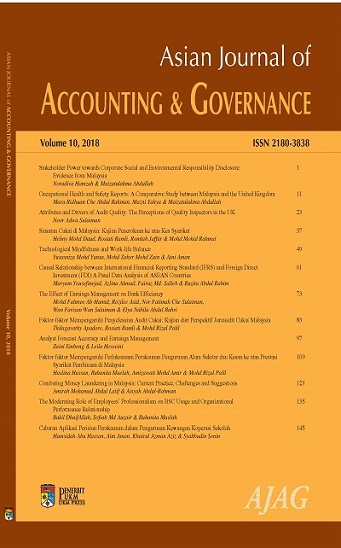
Downloads
Published
2018-11-03
Issue
Section
Articles
License
Authors who publish with this journal agree to the following terms:
- Authors retain copyright and grant the journal right of first publication with the work simultaneously licensed under a Creative Commons Attribution License that allows others to share the work with an acknowledgement of the work's authorship and initial publication in this journal.
- Authors are permitted and encouraged to post their work online (e.g., in institutional repositories or on their website) prior to and during the submission process, as it can lead to productive exchanges, as well as earlier and greater citation of published work (See The Effect of Open Access).
