Combating Money Laundering in Malaysia: Current Practice, Challenges and Suggestions
DOI:
https://doi.org/10.17576/AJAG-2018-10-11Keywords:
Money laundering, AMLA, financial crime, banking institutionsAbstract
Money laundering is a global threat to financial institutions especially the banking industry since it may weaken and expose the institutions to serious risks such as operational, legal and reputational risks. Against this background, the objectives of the study are to analyse the current practice on the prevention of money laundering in selected banks in Malaysia, to investigate the barriers to the implementation of effective Anti-Money Laundering (AML) regulations and to identify the ways to improve the implementation of AML in Malaysia. The study was conducted using qualitative method via interviews with 6 respondents from 6 Islamic & Conventional banks in Malaysia. The preliminary findings showed that the banking institutions’ current practice is fully complying with AML regulations under the AMLA 2001. The findings also demonstrated that the barriers to effective implementation of AML regulations are in line with those of previous study, which are lack of expert staff as the top factor together with an additional factor, which is lack of customers’ education and awareness on money laundering. Hence, to improve the implementation of AML in Malaysia, this study suggested to firstly strengthen the collaboration with government and relevant authorities to ensure strong enforcement action is taken against the criminals. Secondly, collaboration of BNM with banks and local media to increase public awareness and education on financial crime. Thirdly, to invest on employee training, upgrading system management as well as sufficient resources in compliance unit and finally to intensify the “Three Lines of Defence” in Bank Risk Management.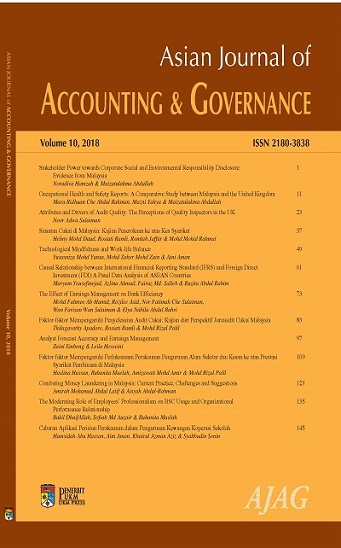
Downloads
Published
2018-11-03
Issue
Section
Articles
License
Authors who publish with this journal agree to the following terms:
- Authors retain copyright and grant the journal right of first publication with the work simultaneously licensed under a Creative Commons Attribution License that allows others to share the work with an acknowledgement of the work's authorship and initial publication in this journal.
- Authors are permitted and encouraged to post their work online (e.g., in institutional repositories or on their website) prior to and during the submission process, as it can lead to productive exchanges, as well as earlier and greater citation of published work (See The Effect of Open Access).
