Corporate Governance Mechanisms, Privatization Method and the Performance of Privatized Companies in Jordan
DOI:
https://doi.org/10.17576/ajag-2013-4-5773Keywords:
Privatization, corporate governance, performance, Jordan, ownership structureAbstract
The present study analyzes the effect of corporate governance mechanisms on the performance of privatized companies in the Jordanian market. Internal and external corporate governance are mechanisms believed to lead to the success of the privatization program. Internal factors, including ownership structure (ownership concentration and type, board members and size) and external factors (audit quality), seemingly affect performance. Different from extant research, the present study analyzes the unique Jordanian market, where close supervision of the privatization program by the royal family is common. An agency perspective, coupled with political intervention, serves as the background for the present study. Privatization methods (for example, strategic partnership versus direct sale) chosen by the said authority are believed to affect the performance of privatized companies. Two-stage least squares (2SLS) and multivariate econometric methodology are used to examine a pool of data from listed companies in the Amman Stock Exchange from 1992 until 2001. The present study finds that the government’s refusal to relinquish control has resulted in the lack of success of the privatization program in Jordan. In contrast, factors demonstrating positive effects on the performance of privatized companies include private ownership concentration; foreign non-Arab ownership; small board size; and audit quality. The strategic partner chosen by the royal family and reduced government intervention positively affects the performance of companies.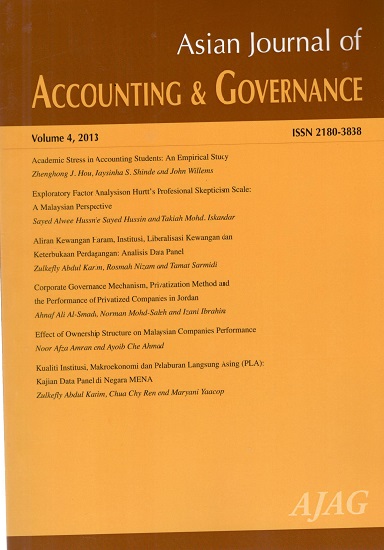
Downloads
Issue
Section
Articles
License
Authors who publish with this journal agree to the following terms:
- Authors retain copyright and grant the journal right of first publication with the work simultaneously licensed under a Creative Commons Attribution License that allows others to share the work with an acknowledgement of the work's authorship and initial publication in this journal.
- Authors are permitted and encouraged to post their work online (e.g., in institutional repositories or on their website) prior to and during the submission process, as it can lead to productive exchanges, as well as earlier and greater citation of published work (See The Effect of Open Access).
