The Quality of Institutions and Foreign Direct Investment (FDI) in Malaysia
DOI:
https://doi.org/10.17576/ajag-2012-3-6516Keywords:
Foreign Direct Investment (FDI), ARDLAbstract
Since the 1990’s, institutional factors have been regarded as playing important roles in stimulating foreign direct investments (FDI). However, empirical studies on their importance in affecting FDI are still lacking, especially in regards to small open economies. This paper attempts to investigate the role of institutions in regards to the inflow of FDI in Malaysia’s small open economy of Malaysia. Using the bounds testing approach (ARDL model), empirical findings reveal that a long-run relationship exists between FDI and institutional variables. Several institutional variables are found to play prominent roles in influencing the inflow of FDI, namely governmental stability, bureaucracy and corruption. Thus, providing and maintaining the quality of domestic institutions alongside the implementation of FDI friendly policies would be beneficial to Malaysian economic growth stemming from foreign investment.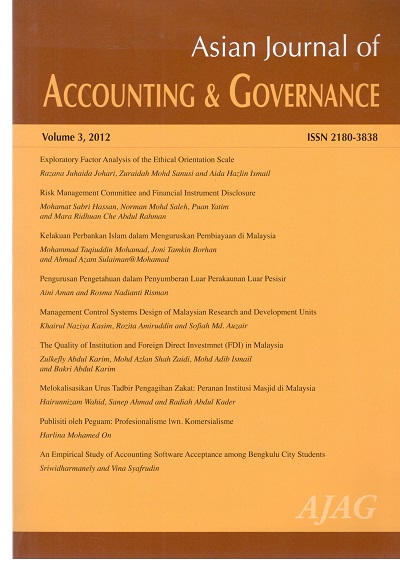
Downloads
Issue
Section
Articles
License
Authors who publish with this journal agree to the following terms:
- Authors retain copyright and grant the journal right of first publication with the work simultaneously licensed under a Creative Commons Attribution License that allows others to share the work with an acknowledgement of the work's authorship and initial publication in this journal.
- Authors are permitted and encouraged to post their work online (e.g., in institutional repositories or on their website) prior to and during the submission process, as it can lead to productive exchanges, as well as earlier and greater citation of published work (See The Effect of Open Access).
