Financial Instruments Disclosure Practices: Evidence from Malaysian Listed Firms
DOI:
https://doi.org/10.17576/ajag-2015-6-8086Keywords:
MFRS 7, financial instruments, financial instrument disclosure practice, corporate governanceAbstract
The current changes in business settings have directed companies to conduct businesses at the international level which requires the use of financial instruments. The mandatory MFRS 7, an adoption of IFRS 7 standard has been implemented for entities to disclose their involvement with financial instruments. Thus, the aim of this study is to investigate the financial instruments disclosure practices ( FID ) among Malaysian listed companies; specifically, on the level of compliance with MFRS 7. The overall results indicate that companies complied with MFRS 7, though there are several requirements omitted by companies. Furthermore, with the revision of Malaysian Code of Corporate Governance (MCCG) in 2012, this study examines the association of corporate governance mechanisms (board expertise, audit committee independence, audit fee, external and internal audit functions) with the extent of FID among companies. Based on a total sample of 319 Malaysian public listed companies for financial year end 2012, the analysis reveals that FID is significantly and positively associated with audit committee independence and external audit functions, while internal audit is negatively associated. Hence, it suggests that effective corporate governance is crucial as this is likely to have some influence on the extent of disclosure level among companies.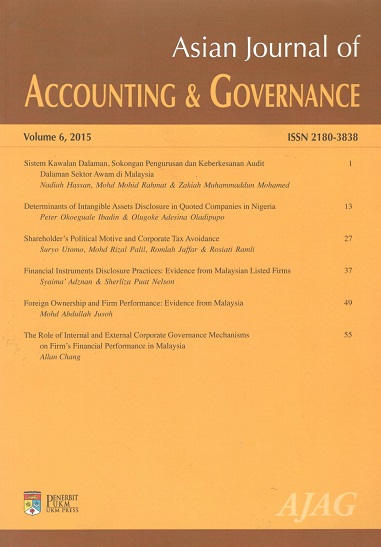
Downloads
Published
2016-02-22
Issue
Section
Articles
License
Authors who publish with this journal agree to the following terms:
- Authors retain copyright and grant the journal right of first publication with the work simultaneously licensed under a Creative Commons Attribution License that allows others to share the work with an acknowledgement of the work's authorship and initial publication in this journal.
- Authors are permitted and encouraged to post their work online (e.g., in institutional repositories or on their website) prior to and during the submission process, as it can lead to productive exchanges, as well as earlier and greater citation of published work (See The Effect of Open Access).
