The Role of Internal and External Corporate Governance Mechanisms on Firm’s Financial Performance in Malaysia
DOI:
https://doi.org/10.17576/ajag-2015-6-8278Keywords:
CEO duality, corporate governance, board practices, independent directors, institutional investors, ownership structures, audit committee, firm performanceAbstract
This paper examined six corporate governance variables which are hypothesized to have an influence on firm’s financial performance in Malaysia. The variables encompassed four internal monitoring measures (CEO and chairman of the board, non-executive directors, audit committee and concentrated ownership) with the remaining two variables being external measures (institutional investors and lenders). An empirical study was conducted based on data involving 420 Malaysian listed companies over a four-year period from 2009 to 2012. A combination of cross-sectional and time-series data was employed in the analysis. An econometric model using panel data regression techniques was employed to analyse performance of the firms using both fixed effects and random effects models. Using return on equity as the dependent variable, it was established that CEO duality (an internal monitoring measure) significantly influences the performance of firms. The study showed that a CEO who is also chairman of the board exerts a positive influence on company earnings. It suggests that CEO duality could increase performance of firms when these CEO s dominate the decision-making process in their companies. None of the other monitoring measures relating to independent directors, institutional investors, ownership structures, audit committee and banks played any role in influencing firm performance.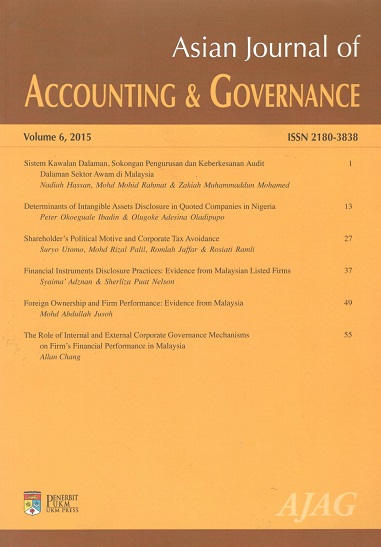
Downloads
Published
2016-02-22
Issue
Section
Articles
License
Authors who publish with this journal agree to the following terms:
- Authors retain copyright and grant the journal right of first publication with the work simultaneously licensed under a Creative Commons Attribution License that allows others to share the work with an acknowledgement of the work's authorship and initial publication in this journal.
- Authors are permitted and encouraged to post their work online (e.g., in institutional repositories or on their website) prior to and during the submission process, as it can lead to productive exchanges, as well as earlier and greater citation of published work (See The Effect of Open Access).
