The Moderating Role of Corporate Governance on the Relationship between a Firm’s Product Lifecycle and Risk-Taking
DOI:
https://doi.org/10.17576/AJAG-2017-08-08Keywords:
Risk-taking, product lifecycle, corporate governance, agency theoryAbstract
Management accounting theories claim that firms experience different risks during different stages of a product’s lifecycle. This study examines the moderating role of corporate governance on the relationship between a firm’s product lifecycle and its risk- taking aspects. The study was conducted from 2006 to 2014 in the Tehran Stock Exchange. We conducted a statistical panel data analysis and the sample consisted of 128 firms (1,152 firm-year observations). The results showed that the decline stage of the product life cycle is the only stage that would affect the risk-taking of the selected firms. Conceivably, there is a positive relationship between the decline stage of the product lifecycle and risk-taking. In addition, the results indicate a positive relationship between the growth and decline stages of a firm’s product lifecycle and its risk-taking when corporate governance plays a moderating role. In short, when corporate governance acts as a moderating variable, the relationship between a firm’s product lifecycle and its risk-taking is lower than the time when there is no such variable. Hence, regulators and managers should consider the role of corporate governance in all the stages of a product’s lifecycle to ensure successful firm decisions and strategies.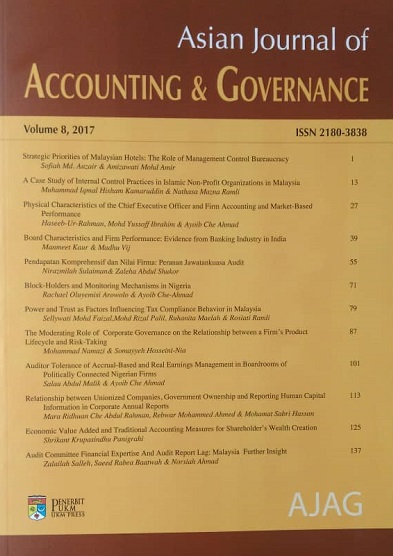
Downloads
Additional Files
Published
2017-11-17
Issue
Section
Articles
License
Authors who publish with this journal agree to the following terms:
- Authors retain copyright and grant the journal right of first publication with the work simultaneously licensed under a Creative Commons Attribution License that allows others to share the work with an acknowledgement of the work's authorship and initial publication in this journal.
- Authors are permitted and encouraged to post their work online (e.g., in institutional repositories or on their website) prior to and during the submission process, as it can lead to productive exchanges, as well as earlier and greater citation of published work (See The Effect of Open Access).
