The Role of Management Control Systems and Automation Implementation Towards Enhancing Indonesian Fintech Company Performance
Keywords:
Management control system, Automation, FinTechAbstract
This study examines the role of Management Control Systems (MCS) in implementing automation within FinTech firms. The study aims to understand how MCS influences and relates to the design of automation systems to enhance overall FinTech performance in the dynamic FinTech environment. Using the quantitative method, the study analyses the relationship between MCS, specifically its dual coercive and enabling formalization aspects, and the design of automation systems. The findings reveal that a well-designed MCS incorporating coercive and enabling formalization can optimize the automation design and improve operational efficiency. This balanced approach enhances the adaptability of automation systems and supports employee performance and innovation, ultimately improving FinTech performance in the fast-paced FinTech industry. The study provides novel insights into the intersection of MCS and automation, offering valuable implications for designing and implementing control systems in technology-driven financial services organizations. It challenges existing assumptions about the rigidity of automated systems. It demonstrates how MCS can introduce a balance between control and flexibility to support the unique needs of the FinTech environment.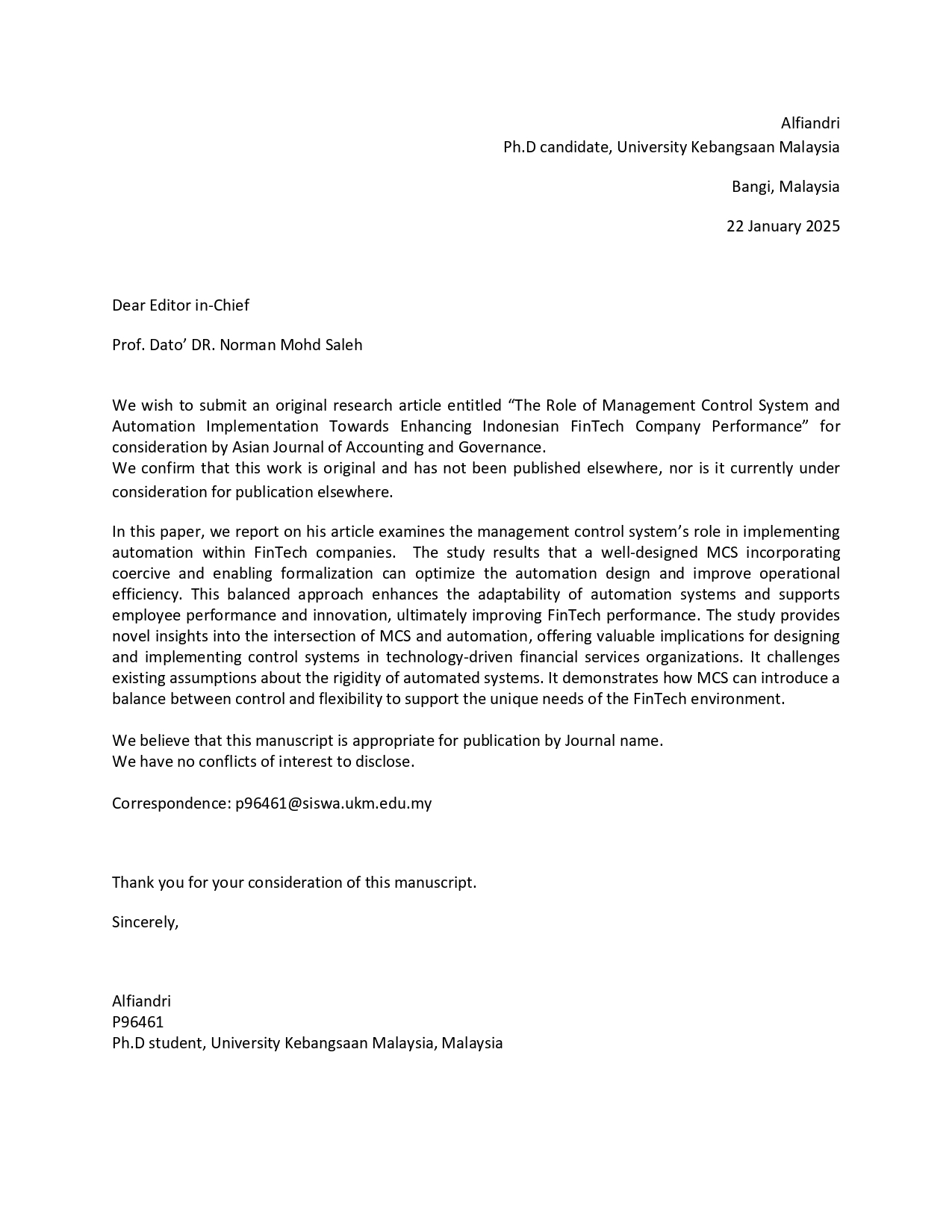
Downloads
Additional Files
Published
2025-04-30
Issue
Section
Articles
License
Authors who publish with this journal agree to the following terms:
- Authors retain copyright and grant the journal right of first publication with the work simultaneously licensed under a Creative Commons Attribution License that allows others to share the work with an acknowledgement of the work's authorship and initial publication in this journal.
- Authors are permitted and encouraged to post their work online (e.g., in institutional repositories or on their website) prior to and during the submission process, as it can lead to productive exchanges, as well as earlier and greater citation of published work (See The Effect of Open Access).
